

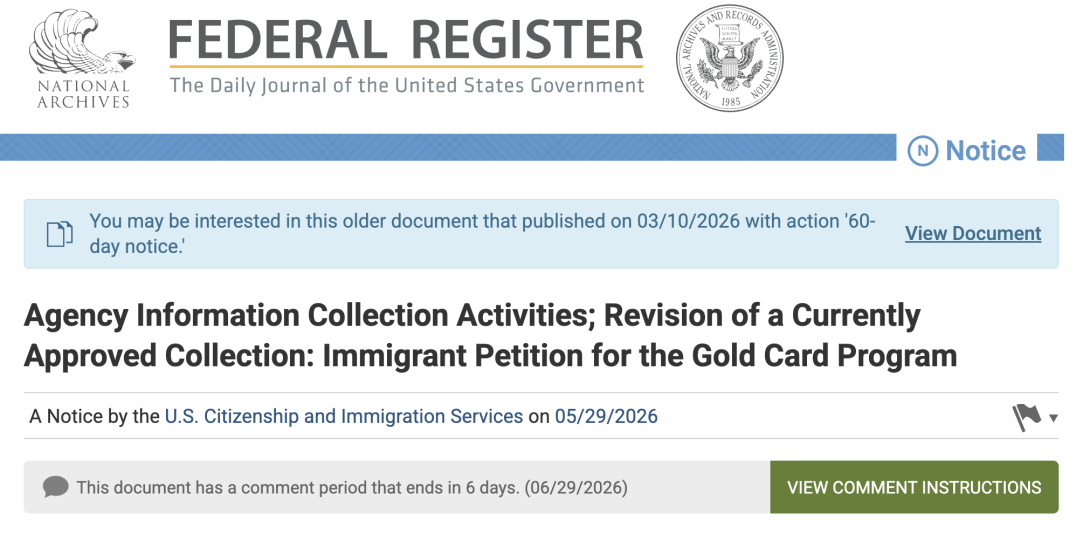
USCIS Publishes Federal Register Notice for Gold Card Immigrant Petition Form I-140G
By C. Matthew Schulz
USCIS appears to be moving forward with an employment-based immigrant petition mechanism for the Trump Gold Card program, using a dedicated Form I-140G rather than the standard Form I-140. The USCIS notice suggests that both individual self-petitions and corporate-sponsored petitions may be contemplated, but it does not provide eligibility criteria, filing fees, investment or contribution requirements, adjudicatory standards, visa-category mechanics, priority-date treatment, or adjustment/consular-processing procedures.
Read the https://www.federalregister.gov/d/2026-10664?utm_campaign=pi+subscription+mailing+list&utm_medium=email&utm_source=federalregister.gov>Federal Register public-inspection notice.
This notice is an early signal of USCIS implementation planning. It should not be treated as final program guidance. The next items to monitor in the bureaucratic process are the final OMB-approved Form I-140G and instructions, any USCIS Policy Manual update, Federal Register rulemaking or implementing notice, and DOS/USCIS guidance on visa classification, numerical limits, admissibility, and processing workflow.
The notice states that DHS and USCIS are submitting the information collection request to the Office of Management and Budget for review and clearance, and there are 30 days for public comment.
The proposed new form is Form I-140G, Immigrant Petition for the Gold Card Program. USCIS states that the form would be used by an individual self-petitioner, or by a corporation or similar entity as a corporate petitioner, to request an employment-based immigrant visa under the Gold Card program established by President Trump without Congressional legislation under Executive Order 14351, The Gold Card, dated September 19, 2025.
This is not, by itself, a final rule creating detailed legal standards for the Gold Card program. It is part of the agency’s paperwork approval process. The notice asks the public to comment on whether the proposed information collection is necessary, whether USCIS’s estimates are accurate, how the collection can be improved, and whether the burden can be reduced through electronic or automated methods.
USCIS previously published a 60-day notice for this same information collection on March 10, 2026, at 91 FR 11559, and received only five comments during that earlier comment period. This new notice gives the public and affected agencies another opportunity to comment before OMB completes its review.
Comments must be submitted through regulations.gov under Docket ID USCIS-2025-0502. Submissions must include OMB Control Number 1615-0167, the agency name, and the docket number.
The most important development is that USCIS is identifying the Gold Card process as an employment-based immigrant visa petition process.
Employment-based immigrant visas are subject to statutory visa categories, numerical limits, priority-date systems, admissibility rules, and adjustment or consular-processing requirements. The notice does not explain how Gold Card applicants would fit within those existing statutory limits, the waiting times that will result, both for Gold Card applicants, and other employment-based immigrants.
The notice also confirms that the contemplated process may include both individual and corporate filers. That distinction may matter if the final program treats a personal contribution differently from a company-sponsored contribution, or if USCIS creates separate evidentiary requirements for self-petitioners and corporate petitioners.
At this stage, potential applicants should be cautious. The Federal Register notice is evidence that USCIS is preparing an administrative form, not that the program is fully operational. Until USCIS releases the final form, instructions, filing procedures, and substantive eligibility rules, applicants and companies will not know what evidence is required, what fees or payments must be made, how long adjudication may take, or whether the program will withstand legal and political scrutiny.
For more background, read my prior article on the Trump Gold Card Executive Order.