


Birthright Citizenship After the Supreme Court: President Trump Tries Again
By C. Matthew Schulz
President Donald Trump issued new executive actions on August 6, 2026, addressing birth tourism and birthright citizenship only weeks after the Supreme Court rejected his Administration’s earlier attempt to deny citizenship to certain children born in the United States. The actions target both the use of temporary visas to enter the United States for the purpose of giving birth and, through a companion order, federal recognition of citizenship for additional categories of U.S.-born children.
The White House published the full text of the Executive Order, “Ending Birth Tourism”. The State Department subsequently issued a Fact Sheet entitled State Department Establishes Task Force to End Birth Tourism.
The distinction between birth tourism and birthright citizenship matters. The federal government possesses broad authority to regulate visas and admission to the United States. It can investigate visa fraud, deny visas or admission when permitted by law, and take enforcement action against businesses or individuals that facilitate immigration fraud.
Whether the President can declare that a child actually born in the United States is not a citizen presents a very different constitutional question. The Fourteenth Amendment speaks directly to citizenship at birth, and the Supreme Court addressed that constitutional question only weeks before President Trump issued the new orders.
Major News Coverage
The August 6 actions immediately attracted national attention. Major news organizations have examined both the new birth-tourism measures and the Administration’s renewed effort to restrict birthright citizenship.
Coverage and additional analysis include:
Birth tourism exists, and, to the extent that there is sometimes visa fraud associated, it can legitimately be investigated and prosecuted.
But birth tourism and birthright citizenship are not synonymous. The constitutional question is much broader: whether a child born in the United States and subject to its jurisdiction acquires American citizenship at birth.
The Supreme Court Just Addressed the Constitutional Question
The timing of the new executive actions is particularly significant.
On June 30, 2026, the Supreme Court decided Trump v. Barbara. The Court rejected President Trump’s earlier attempt to deny birthright citizenship to children born in the United States based on their parents’ immigration status.
The Court held that children born in the United States to parents who are unlawfully or temporarily present are “subject to the jurisdiction” of the United States and therefore citizens at birth under the Citizenship Clause of the Fourteenth Amendment.
President Trump’s earlier January 20, 2025 executive order, “Protecting the Meaning and Value of American Citizenship,” is available at: Protecting the meaning and value of American citizenship.
The August 2026 actions therefore do not arise on a blank constitutional slate. They follow immediately after a Supreme Court decision addressing the Administration’s central constitutional argument.
Birthright Citizenship Is a Reconstruction-Era Constitutional Guarantee
Birthright citizenship is not a modern immigration program. It is part of the Constitution.
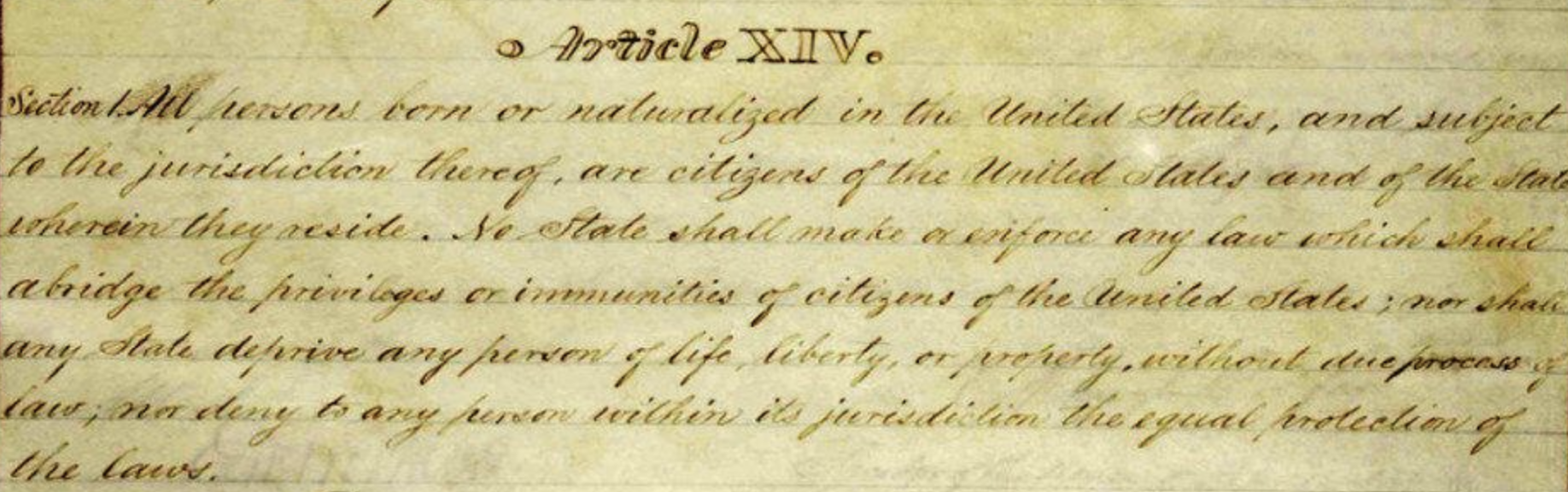 The Fourteenth Amendment was ratified in 1868 after the Civil War. Its first sentence provides:
“All persons born or naturalized in the United States, and subject to the jurisdiction thereof, are citizens of the United States and of the State wherein they reside.”
The Citizenship Clause repudiated one of the most infamous decisions in Supreme Court history, Dred Scott v. Sandford, which had held that Black Americans could not be citizens of the United States.
The Fourteenth Amendment fundamentally changed that rule. National citizenship became a constitutional status rather than something an ordinary political majority could selectively grant or withhold.
Congress's Constitution Annotated provides useful historical background. See Fourteenth Amendment.
Thirty years after ratification, the Supreme Court decided United States v. Wong Kim Ark, 169 U.S. 649 (1898).
Wong Kim Ark was born in San Francisco to Chinese parents at a time when federal law severely discriminated against Chinese immigrants and prevented them from naturalizing. After Wong returned from a trip abroad, the federal government attempted to prevent him from reentering the United States.
The Supreme Court held that Wong was an American citizen because he had been born in the United States and was subject to its jurisdiction.
The traditional exceptions to birthright citizenship have been exceptionally narrow, most notably children born to accredited foreign diplomats and, historically, children born to enemy forces occupying American territory. The Constitution does not contain a general exception based on whether the government approves of a child's parents, their immigration status, or their reason for being in the United States.
The Supreme Court did not invent birthright citizenship in 2026. It addressed a constitutional guarantee adopted in 1868 and interpreted by the Court more than a century ago.
Becoming a Citizen Is Becoming More Expensive and More Demanding
The birthright-citizenship controversy also deserves to be considered alongside the Administration's other citizenship policies.
For lawful permanent residents seeking to become American citizens through naturalization, several recent or proposed changes move toward greater expense or more demanding requirements.
USCIS introduced a substantially expanded naturalization civics examination in 2025. Applicants subject to the new examination study 128 potential civics questions rather than 100. An officer may ask as many as 20 questions, and the applicant must correctly answer 12 to pass.
USCIS provides the official test materials at Civics Test.
The Administration is also considering additional changes. DHS's regulatory agenda includes a proposed rule entitled “Protecting the Integrity of Naturalization through Enhanced Educational Standards.” The contemplated rule would establish additional standards for satisfying naturalization's educational requirements and provide USCIS greater flexibility in administering the tests.
Because that rule has not yet been finalized, its eventual requirements remain unknown.
The Administration has separately proposed substantially increasing the cost of applying for naturalization. The proposed fee rule would raise the standard Form N-400 filing fee from $760 to $1,330 for paper applications and from $710 to $1,280 for online applications. It would also restrict the availability of reduced fees and fee waivers, subject to specified exceptions.
These changes matter because naturalization is the principal pathway through which lawful permanent residents become full members of the American political community.
At the Same Time, Giving Up Citizenship Is Becoming Less Expensive
The policy direction is different for Americans who voluntarily relinquish or renounce citizenship.
Effective April 13, 2026, the Department of State reduced the fee associated with processing a Certificate of Loss of Nationality from $2,350 to $450.
The prior $2,350 charge had been criticized for years as an unusually high governmental fee for exercising the right to expatriate. Reducing it can therefore be defended independently as a reasonable administrative change.
Nevertheless, the contrast is notable.
The government has proposed substantially increasing the cost of becoming a citizen through naturalization while substantially reducing the government fee associated with formally giving up citizenship. Those policies need not share a single motive to deserve consideration together. Their practical effects move in opposite directions.
The Government Is Also Expanding Denaturalization Enforcement
Citizenship obtained through naturalization has never been completely immune from revocation.
Federal law permits the government to bring a civil denaturalization action when it contends that citizenship was illegally procured or obtained through concealment of a material fact or willful misrepresentation. Denaturalization ordinarily requires judicial proceedings; the executive branch cannot simply cancel valid citizenship because it later disapproves of a naturalized citizen.
The Trump Administration has made denaturalization a substantially more prominent enforcement priority.
The Department of Justice has announced multiple civil denaturalization cases involving allegations including terrorism support, war crimes, sexual offenses, fraud, immigration fraud and other serious misconduct. In July 2026, DOJ described its initiative as the “largest denaturalization effort ever.”
The allegations in these cases are serious. Nothing about the constitutional importance of citizenship prevents the government from seeking denaturalization when Congress has authorized it and the government can prove the statutory requirements in court.
The significance lies instead in the scale and priority assigned to the remedy. Citizenship policy now includes a substantially expanded governmental effort to examine circumstances under which citizenship previously obtained through naturalization can be judicially revoked.
Taken Together, the Administration's Citizenship Policies Deserve Attention
Each of these policies has its own asserted justification.
The Administration argues that birth tourism abuses the immigration system. A more demanding naturalization examination can be defended as promoting civic knowledge. Higher application fees can be justified as recovering administrative costs. A lower expatriation fee can be defended as eliminating an excessive barrier to relinquishing citizenship. Denaturalization remains an established remedy for citizenship obtained unlawfully.
It would therefore be an overstatement to claim that every policy reflects a single provable governmental motive.
But their cumulative effect remains important.
During a relatively short period, the federal government has:
- twice attempted to restrict recognition of birthright citizenship;
- expanded the naturalization civics examination;
- proposed additional naturalization educational requirements;
- proposed substantially higher naturalization fees;
- substantially reduced the fee for formally relinquishing or renouncing citizenship; and
- dramatically increased the institutional emphasis on denaturalization.
The facts reflect an unusually active period of federal policymaking concerning who becomes an American citizen, how difficult and expensive that process should be, who may relinquish citizenship, and when citizenship already granted may be challenged.
Citizenship and the Constitutional Allocation of Election Authority
Citizenship also determines membership in the American political community, including eligibility to vote in federal elections. That makes another development relevant: the Administration's effort to increase federal executive involvement in election administration and citizenship verification.
This issue requires some constitutional precision.
The Constitution does not leave federal election regulation exclusively to the states.
Article I, Section 4—the Elections Clause—provides that state legislatures initially prescribe the “Times, Places and Manner” of congressional elections, but it expressly gives Congress authority to “make or alter” those regulations.
Congress therefore possesses substantial constitutional authority over federal elections.
The important distinction is that the Constitution assigns that federal legislative authority to Congress, not to the President.
State and local governments also continue to perform the overwhelming majority of election administration in the United States, subject to federal constitutional and statutory requirements.
Against that constitutional structure, President Trump has pursued greater executive-branch involvement in election administration, including federal citizenship-verification initiatives and efforts to obtain state voter-registration information.
The Administration argues that these measures protect election integrity and ensure that only eligible citizens participate in federal elections.
Opponents contend that some of the measures exceed presidential authority, interfere with powers retained by the states, or attempt to accomplish through executive action changes that constitutionally require legislation from Congress.
Courts have consequently become important arbiters of where those lines fall.
This debate should not be reduced to the proposition that the federal government has no role in elections. That would be constitutionally incorrect. Congress plainly has substantial authority.
The more precise constitutional question is which part of the federal government possesses that authority, what Congress has actually authorized by statute, and how far the executive branch may go on its own when directing state election administration or demanding state election data.
That question has an important connection to the citizenship debate without being legally identical to it.
One controversy asks: Who is an American citizen?
The other asks: Who determines the rules under which citizens participate in choosing their government?
The Constitution answers both questions by allocating governmental authority rather than concentrating it in one institution. The Fourteenth Amendment constitutionalizes citizenship. The Elections Clause divides election authority between states and Congress. Federal statutes impose additional requirements. Courts determine whether government actors remain within those constitutional and statutory boundaries.
That separation of powers is not a technicality. It is part of the constitutional protection itself.
Immigrants Have Helped Build, Defend and Transform the United States
Citizenship debates can easily become debates about what immigrants receive from the United States. That tells only half of the story.
Immigrants have also built, defended, invented, invested in and transformed the United States.
Military Service
Immigrants have served in the American armed forces throughout the country's history.
Foreign-born soldiers fought for the United States during the Civil War and both World Wars. Immigrants served during Korea, Vietnam, the Gulf War and the post-September 11 conflicts. Many served before they became citizens.
Congress has repeatedly recognized military service as a particularly important pathway to citizenship. Today, special naturalization provisions continue to apply to qualifying members of the U.S. armed forces.
Information about military naturalization is available from USCIS at Naturalization through military service.
Military service presents citizenship in its most concrete form. Generations of immigrants have been willing to risk their lives for the United States, sometimes before the United States formally recognized them as citizens.
Science and Innovation
The American scientific enterprise likewise depends heavily on immigrants.
Foreign-born scientists, engineers, physicians, researchers and university faculty have made enormous contributions to American medicine, computing, aerospace, engineering and basic science.
The National Science Foundation reports that foreign-born workers constitute a substantial portion of America's science and engineering workforce, with an especially significant presence among workers holding advanced degrees.
Official statistics are available from the National Center for Science and Engineering Statistics.
The contribution is not simply quantitative.
Immigrant scientists have helped the United States win Nobel Prizes, develop new medicines, build the semiconductor and computer industries, advance artificial intelligence, explore space and maintain American leadership in scientific research.
Many eventually naturalized. Their children were Americans from birth.
Business and Entrepreneurship
Immigration has also played a central role in American entrepreneurship.
Immigrants have founded neighborhood businesses, manufacturing companies and some of the world's most valuable technology companies. They employ American workers, pay taxes, develop new products and create industries that did not previously exist.
Research consistently finds that immigrants start businesses at high rates and make disproportionately large contributions to American innovation.
That contribution is not confined to Silicon Valley.
Immigrant entrepreneurs operate restaurants, construction companies, professional practices, farms, manufacturers, transportation businesses and thousands of other enterprises throughout the country.
They participate in precisely the economic activity that has historically allowed successive generations of Americans to move into the middle class.
Citizenship Is More Than an Immigration Benefit
Reasonable people can disagree about immigration levels, border enforcement, visa fraud, naturalization standards and how aggressively the government should pursue people who obtained immigration benefits through fraud.
Birth tourism itself is a legitimate subject for immigration enforcement when applicants misrepresent the purpose of their travel or commercial operators facilitate fraud.
But citizenship occupies a different constitutional position.
The Fourteenth Amendment deliberately placed citizenship in the Constitution following a Civil War fought in substantial part over the meaning of national membership and equality. United States v. Wong Kim Ark applied that guarantee to the American-born child of immigrants in 1898. The Supreme Court again confronted the constitutional meaning of birthright citizenship in 2026.
Citizenship should therefore be understood as more than an immigration benefit administered at the discretion of the government.
It defines membership in the American constitutional community.
That community has never been static. Generation after generation, people arrived in the United States, became Americans, served in its military, started businesses, made scientific discoveries, raised families and participated in its democracy. Their children became Americans too.
The current debate consequently raises questions larger than birth tourism or immigration enforcement. It asks how the United States defines citizenship, how difficult the government should make citizenship to obtain, under what circumstances citizenship can be lost, and which institutions possess the constitutional authority to make those decisions.
Those are questions about immigration law. They are also questions about the structure of American constitutional government.
For additional SchulzLaw articles concerning U.S. citizenship, naturalization and immigration law, visit: President Trump’s Executive Orders on Immigration: Birthright Citizenship, Visa Vetting, and Policy Reversals. SchulzLaw Blog February 2, 2025.